
Supreme Court Push for ICU Standards: A Wake-Up Call for Healthcare Infrastructure
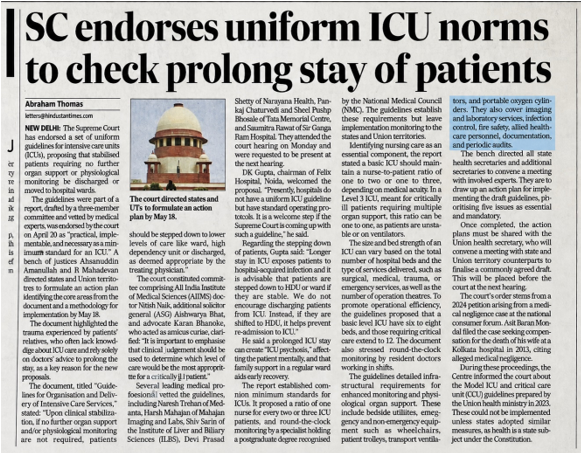
Supreme Court Push for ICU Standards
A Wake-Up Call for Healthcare Infrastructure
The recent directive by the Supreme Court of India on standardizing ICU norms marks a significant milestone in strengthening India’s healthcare ecosystem. While the focus is often placed on clinical excellence, this move highlights an equally critical but sometimes overlooked aspect — engineering and infrastructure in patient care, particularly HVAC systems in Intensive Care Units.International and Indian standards such as ASHRAE 170 clearly define the requirements for HVAC systems in ICUs. These standards go beyond temperature control, emphasizing humidity regulation, air changes per hour (ACH), filtration efficiency, and infection control. However, in many healthcare facilities, especially when compared to operation theatres, ICU HVAC systems often face compromises due to capital cost considerations.The consequences of such compromises are serious yet often invisible.
The Hidden Threat: ICU-Acquired Infections
ICU-acquired infections remain a major concern, with nearly one-third attributed to cross-infection, typically emerging after 5–7 days of patient stay. In such environments, even healthcare providers can inadvertently become vectors of infection transmission.While infection control protocols—such as hand hygiene, barrier precautions, surface disinfection, and antibiotic stewardship—play a vital role, the design and performance of HVAC systems are equally critical in minimizing airborne contamination.
Proper ICU HVAC Design Ensures:
Controlled airflow patterns Adequate filtration (HEPA where required) Optimal humidity levels to inhibit microbial growth Sufficient fresh air exchange
Engineering Responsibility in Healthcare Outcomes
The Supreme Court’s endorsement of ICU norms is more than a regulatory step—it is a call to action for the entire healthcare ecosystem to align clinical practices with engineering excellence.Because ultimately, patient outcomes should never reflect the old paradox:
“Operation successful, but patient lost.”Our Commitment at CSquare Engineering
At CSquare Engineering, we believe that responsibility in HVAC design directly contributes to patient safety and recovery. Our ICU solutions are designed and executed in strict accordance with ASHRAE 170-2017, ensuring compliance with global best practices.
We Are Committed To:
Delivering high-performance HVAC systems for critical care environments Ensuring accountability in design and execution Supporting healthcare providers in building safer, infection-controlled ICUs
Conclusion
The future of healthcare lies not only in advanced treatments but also in robust infrastructure that supports those treatments. With regulatory momentum now in place, this is the right time for hospitals and stakeholders to rethink ICU design—from the ground up.Because in critical care, every detail matters—even the air patients breathe.